
INDEX-NATION
“Comparison is the thief of joy.”
Theodore Roosevelt
July is a big month for anniversaries, both for our nation and its investors. While there may be fewer parades, July 3rd marks the 142nd anniversary of the first equity index, the Dow Jones Average. Published in the Customers’ Afternoon Letter (a two-page precursor to The Wall Street Journal), it consisted of eleven companies, nine of which were railroads (so much for diversification). Using little more than basic division, Charles Dow launched an industry against which trillions are now allocated. For evidence of how powerful indices have become, see the recent kerfuffle over whether SpaceX would be allowed to join the S&P 500. You could fit nineteen S&P Globals comfortably inside the market cap of one SpaceX, but the high priests of finance bend the knee to no one.
I’ve been running this strategy now for six-and-a-half years (26 quarters), and last quarter was the fund’s largest underperformance on record. While a 7% quarter is respectable in almost any market, given the current backdrop, it may underwhelm. You’re free to interpret these results how you like, but if you’ll indulge me, there are a few points that need making.
INDEX AGNOSTIC
When launching a de novo fund, many managers start from an index and work backwards. They think ‘tech is 17% of the benchmark and I really like tech, so I’ll overweight it by a few percent,’ then repeat this process across the remaining ten sectors. This is known as a top-down approach, and while it creates predictable portfolios (performance leans benchmark-like), it rarely leads to exceptional outcomes.
I take the opposite tack. I start with individual companies, assess their risk and potential, then let position sizing reflect my conviction. The result can be significant concentration in one sector or complete absence from another. This reduces the fund’s marketability but increases its odds of differentiated returns (in both directions). I’m sure some managers have discovered how to beat an index while only painting around its edges, but I’m not one of them.
Since inception, 13% of the fund’s capital was invested in consumer staples, yet they make up just 2% of the benchmark, an active bet so large it would give most institutional allocators angina. In the past 18 months, staples were the worst performing sector (they’re up just 8%), yet the fund’s holdings have risen 44%. I’ve always found it easier to evaluate a single business than guess which sector the market might favor next.
You’ve probably noticed that AI-beneficiaries are having a pretty good year (small cap tech stocks rose 56% in the second quarter) leaving the market exceptionally narrow. According to MSCI data dating back to 1991, April and March were the two best relative months for momentum stocks on record.
As a self-avowed contrarian, I tend to shy away from crowded trades. In February of last year, I wrote that you likely have enough AI exposure and don’t need me adding more. Tech makes up 17% of the index, but only 5% of the fund. When combined with cash, these two decisions explain three-quarters of the year’s underperformance. Had I chased AI, results would doubtless be better, but this would increase the fund’s similarity to your other holdings, negating its value proposition. Should AI or the momentum trade eventually falter, investors may appreciate this diversification more than they do now.
CAPITAL PRESERVATION
There are two types of risks when selecting a manager: performance risk and capital risk. Performance risk is the potential a fund underperforms its benchmark, capital risk is actually losing money. I find the former more palatable than the latter.
An index-like fund takes little performance risk, but plenty of capital risk. If the market sells off 20%, they can say ‘we were only down 18%.’ Since my fund features a high-water mark, I’m incentivized to preserve capital which could mean foregoing some return. I’ve found that investors tend to appreciate this feature in down markets but resent it when they surge.
I would describe Epigram Capital Partners Fund I as having high performance risk, but low capital risk (at least historically). The strategy has never had a down year before fees and outperformed in all but one down month (a 97% hit rate). While obviously subject to change, this trade-off has meant giving up some of the market’s upside, but over a cycle, it’s managed to deliver superior returns.
RISK ADJUSTED
Hedge funds were created in the 1940s to reduce risk by buying some securities and shorting others. The idea being that you could isolate stock picking skill regardless of the direction of the market and generate returns that didn’t move in lockstep with the rest of your holdings.
Returns are easy to measure, but I suspect the investing public finds most risk metrics more confusing than enlightening. While I invite comparison with the benchmark by displaying it prominently in my letters, there’s an important caveat. By buying profitable companies with conservative balance sheets, low economic sensitivity and robust capital returns, the fund has historically taken far less risk than the market. When evaluating performance, it’s vital that you consider risks taken. A fund that outperforms by 10% in an upmarket but underperforms by 20% during selloffs is not a good product.
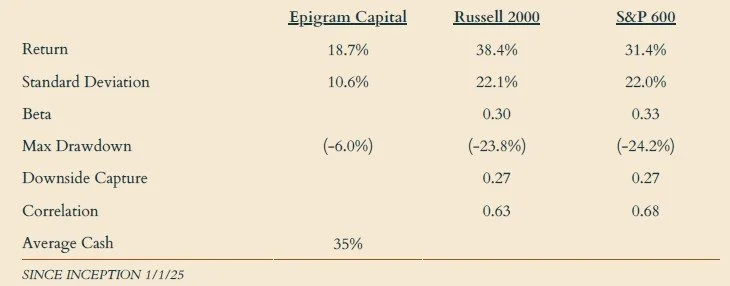
You’re free to draw your own conclusions, but the one I’d offer is that the fund has delivered 50-70% as much return while taking 25-50% as much risk (depending on metric and benchmark). While it’s true that you can’t spend risk-adjusted returns, if these ratios hold (a big if), the fund is likely to outperform over a cycle, provided you can tolerate underperformance during strong markets. Low correlation (at least for a long-only fund) confirms it’s not very benchmark-like. The cash level is an average since inception and was 9% at the end of the second quarter.
Part of this conservativism stems from wanting to be intentional when scaling a new fund. The remainder was my view that markets have grown increasingly complacent about risk. There are times to be aggressive (like 2020), and times to be patient (like now). Although it would appear I misjudged the second quarter, I’m willing to look foolish in the beginning, provided I don’t look foolish in the end.
RUN IT HOT
A fund that takes less risk than its benchmark will always look its worst during periods of froth. The Russell 2000 returned 23% in the second quarter, 12% of which came in April, the ninth best month in the index’s history. Since 1979, only eight months have been better, many of which occurred during a crisis and were the side-effect of resuscitating an ailing economy. The lone exception was February 2000, which you might remember as peak dot com enthusiasm.
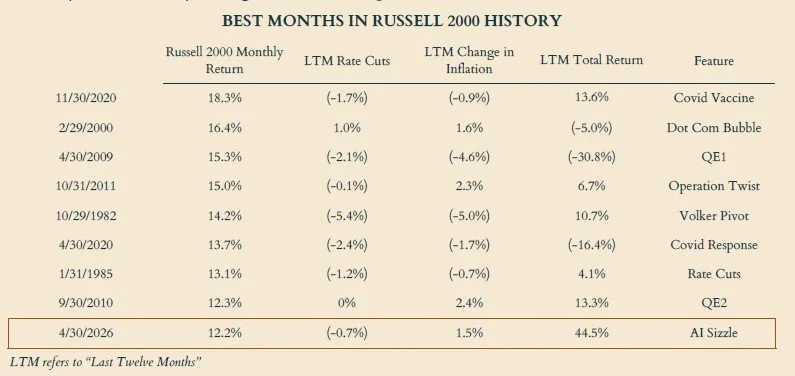
The strength of the market has caught many by surprise, including yours truly, since many of the hallmarks of a market tear seem to be absent. For starters, consumer confidence is at an all-time low and real purchasing power in decline. The market entered 2026 expecting more rate cuts, while the Fed now seems to favor hikes. While it’s true that earnings growth has been robust, inflation progress has reversed due to the conflict in Iran. Relative to history, interest rates and inflation, many stocks screen expensive. Lastly, small caps aren’t exactly bouncing off a bottom, having risen 75% since last April. While strong returns can occur in such an environment (they just did), most wouldn’t have thought them likely.
TIMING MATTERS
I’ve often wondered if the investing public appreciates that when you measure is as important as what you measure. The fund that looks best at a market peak is usually the one that took the most risk. While this is certain to attract assets in the short term, the moment sentiment sours, they often give back their outperformance and then some. If you think I over-generalize, feel free to revisit the leaderboard from 1999.
The proper way to evaluate performance is over a cycle which is why most institutions insist on a five-year track record when vetting a manager. There’s nothing magical about a five-year period, except it usually contains a bear market, a vital ingredient when measuring risk. Epigram Capital’s goal is to deliver compelling risk-adjusted returns through a cycle, not to maximize performance in any given quarter.
CONCLUSION
Friends ask if I’m disappointed in the fund’s performance, but when you look under the hood, it’s doing exactly what it’s supposed to do: provide differentiated returns, take less risk and zig when the market zags. When reviewing the fund’s performance, I hope you’ll remember the following:
· The fund ignores the index. This increases the odds of differentiated returns in both directions.
· The fund avoided AI stocks, not out of skepticism, but to avoid replicating your other holdings.
· When measuring returns, you must consider risk. The fund is incentivized to preserve capital and prefers performance risk to capital risk.
· Return comparisons are sensitive to measurement period. A risk-on fund will always look best at the top and vice versa.
Thank you for reading and Happy Birthday America!
Sincerely,
Dan Walker